

Stop Discounting. Start Justifying.
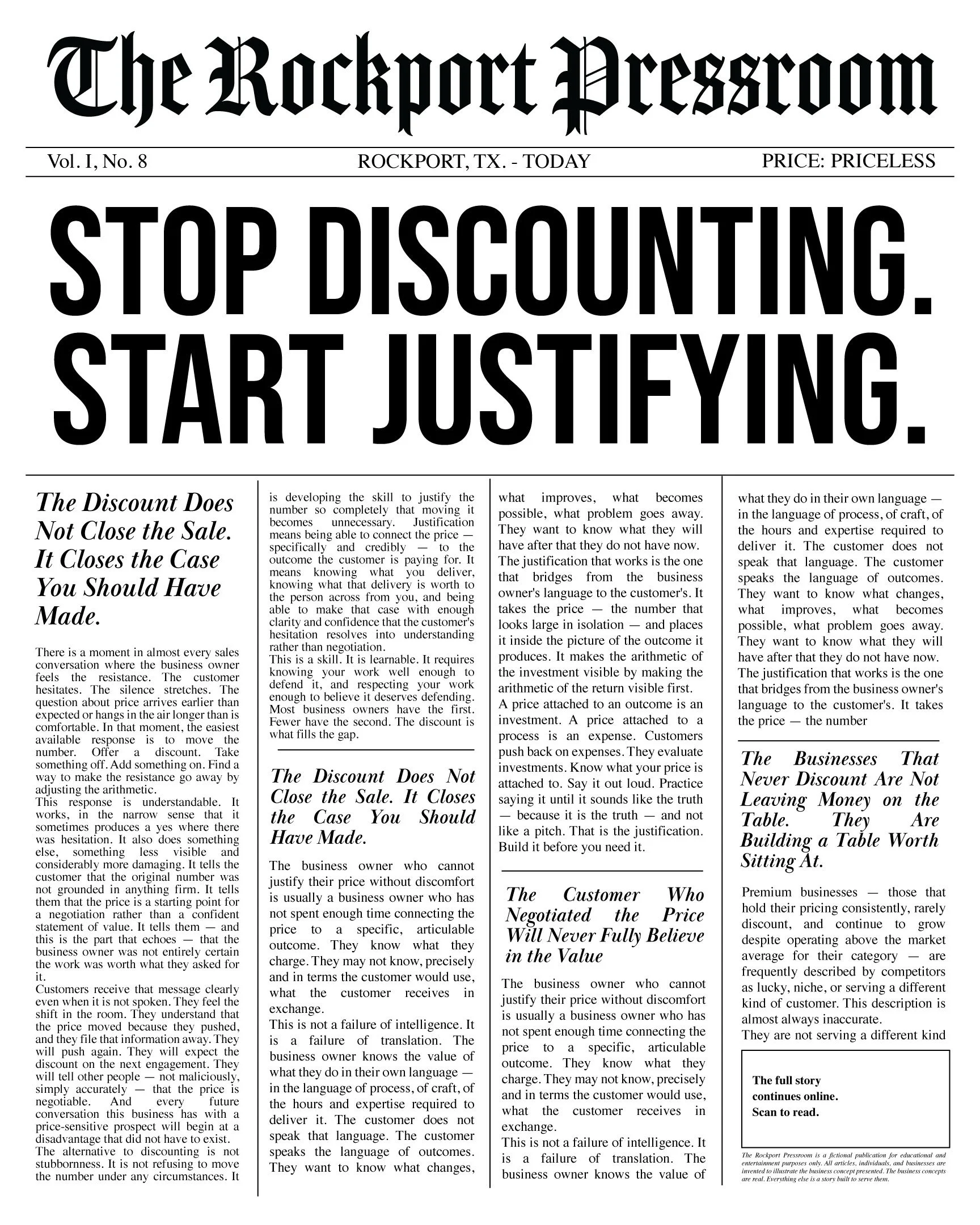
The Rockport Pressroom Mock Poster
The Discount Is Not a Sales Tool. It Is an Admission.
Every time you lower the price without changing the offer, you are telling the customer something about what you believe your work is worth. They are listening. They believe you.
The Discount Does Not Close the Sale. It Closes the Case You Should Have Made.
There is a moment in almost every sales conversation where the business owner feels the resistance. The customer hesitates. The silence stretches. The question about price arrives earlier than expected or hangs in the air longer than is comfortable. In that moment, the easiest available response is to move the number. Offer a discount. Take something off. Add something on. Find a way to make the resistance go away by adjusting the arithmetic.
This response is understandable. It works, in the narrow sense that it sometimes produces a yes where there was hesitation. It also does something else, something less visible and considerably more damaging. It tells the customer that the original number was not grounded in anything firm. It tells them that the price is a starting point for a negotiation rather than a confident statement of value. It tells them — and this is the part that echoes — that the business owner was not entirely certain the work was worth what they asked for it.
Customers receive that message clearly even when it is not spoken. They feel the shift in the room. They understand that the price moved because they pushed, and they file that information away. They will push again. They will expect the discount on the next engagement. They will tell other people — not maliciously, simply accurately — that the price is negotiable. And every future conversation this business has with a price-sensitive prospect will begin at a disadvantage that did not have to exist.
The alternative to discounting is not stubbornness. It is not refusing to move the number under any circumstances. It is developing the skill to justify the number so completely that moving it becomes unnecessary. Justification means being able to connect the price — specifically and credibly — to the outcome the customer is paying for. It means knowing what you deliver, knowing what that delivery is worth to the person across from you, and being able to make that case with enough clarity and confidence that the customer's hesitation resolves into understanding rather than negotiation.
This is a skill. It is learnable. It requires knowing your work well enough to defend it, and respecting your work enough to believe it deserves defending. Most business owners have the first. Fewer have the second. The discount is what fills the gap.
To Justify the Price You Must First Know What the Price Is Attached To
The business owner who cannot justify their price without discomfort is usually a business owner who has not spent enough time connecting the price to a specific, articulable outcome. They know what they charge. They may not know, precisely and in terms the customer would use, what the customer receives in exchange.
This is not a failure of intelligence. It is a failure of translation. The business owner knows the value of what they do in their own language — in the language of process, of craft, of the hours and expertise required to deliver it. The customer does not speak that language. The customer speaks the language of outcomes. They want to know what changes, what improves, what becomes possible, what problem goes away. They want to know what they will have after that they do not have now.
The justification that works is the one that bridges from the business owner's language to the customer's. It takes the price — the number that looks large in isolation — and places it inside the picture of the outcome it produces. It makes the arithmetic of the investment visible by making the arithmetic of the return visible first.
A price attached to an outcome is an investment. A price attached to a process is an expense. Customers push back on expenses. They evaluate investments. Know what your price is attached to. Say it out loud. Practice saying it until it sounds like the truth — because it is the truth — and not like a pitch. That is the justification. Build it before you need it.
The Customer Who Negotiated the Price Will Never Fully Believe in the Value
There is a downstream consequence to discounting that most business owners do not examine because it arrives after the sale is closed and the relief of having closed it has faded. The customer who pushed the price down and succeeded is not the same customer as the one who paid the stated rate.
The customer who negotiated carries a quiet skepticism into the engagement. They got the price down, which means the original price was too high, which means they are already wondering whether the value is what was claimed. They are more likely to question decisions made during the work. They are more likely to scrutinize the final invoice. They are more likely to feel, at the end of the engagement, that something was not quite right — not because the work was poor but because the seed of doubt was planted the moment the price moved.
The customer who paid the stated rate without negotiation did so because they believed the case that was made for it. They arrive with confidence in the investment they have made. They are more likely to trust the decisions made during the work. They are more likely to feel, at the end of the engagement, that they received what they paid for — because they entered believing they would.
The price you hold communicates something about the outcome the customer can expect. The price you allow to move communicates the same thing in the opposite direction. Decide what you want the customer to believe when they arrive. Then price accordingly and hold it.
The Businesses That Never Discount Are Not Leaving Money on the Table. They Are Building a Table Worth Sitting At.
Premium businesses — those that hold their pricing consistently, rarely discount, and continue to grow despite operating above the market average for their category — are frequently described by competitors as lucky, niche, or serving a different kind of customer. This description is almost always inaccurate.
They are not serving a different kind of customer. They are attracting a different kind of customer, and they are attracting them because of how they behave around price. A business that holds its rate communicates confidence. Confidence attracts customers who are looking to buy based on trust rather than customers who are looking to buy based on price. These are different populations. The population that buys on trust is more loyal, less demanding, more likely to refer, and more likely to return. They are also more likely to pay the next increase without significant resistance, because the trust was established at the beginning and has been reinforced since.
The discount-free business is not leaving money on the table. It is selecting its customers through the act of holding firm. Every business that discounts is also selecting its customers — it is selecting the ones who pushed back, who tested the price, who entered the engagement with skepticism. Both businesses get the customers their pricing behavior attracts.
Stop discounting. Build the justification. Attract the customers who respond to it. That is not a strategy for a certain kind of business. It is a strategy for any business willing to do the harder work of knowing what it is worth and saying so with conviction.
Readers Respond — On the Price They Held and What Happened After
I discounted for six years. I told myself I was being flexible and customer-friendly. What I was being was afraid. When I finally stopped discounting and built an actual case for my rates, I lost three clients who were only there because of the price. I gained four others within ninety days who have never once questioned an invoice. My revenue went up. My stress went down. I spent six years solving the wrong problem. — A service provider. Rockport, Texas.
I asked a mentor once how she handled clients who pushed back on her rate. She said she welcomed it. She said pushback meant the client was still in the conversation and still interested. She said her job in that moment was not to lower the number but to raise the clarity. She asked what outcome they were hoping for and then she built the bridge from that outcome back to the number. She said she had not discounted in eleven years. I believed her. I still do. — A consultant. San Antonio, Texas.
My husband runs a small cabinet shop. He does not discount. He has a six-month waiting list. People ask him how he built the list without advertising and he tells them he held his price for fifteen years. He says the waiting list is what the price built over time. He says a customer who waits six months for your work does not arrive wondering if it was worth it. — Submitted by a reader. Rockport, Texas.
In Brief — Notes on Pricing, Patience, and What Holds
Business Holds Rate; Client Accepts; Relationship Strengthens A Coastal Bend creative firm reports that a longtime client pushed back on a recent rate increase citing budget constraints. The firm held the increase and offered instead to scope the engagement differently at the existing rate. The client accepted the revised scope at the new rate. The relationship, the firm reports, is stronger than it was before the conversation. The firm attributes the outcome to the quality of the justification and the decision not to move the number.
Discounted Client Proves Most Difficult in Firm History A regional service business confirms that the client who negotiated the largest discount in the firm's history also generated the most complaints, required the most revision cycles, and produced the lowest net margin of any engagement in a five-year period. The firm has since adopted a firm pricing policy. Early results described as a significant improvement in client quality.
Justification Attempted; Sale Closed at Full Rate A first-time business owner who had previously relied on discounting to close hesitant prospects reports successfully closing a sale at full rate for the first time after spending twenty minutes connecting the price to a specific outcome the client had described wanting. The client did not ask for a discount. The owner reports being surprised. Editors are not surprised.
Brief 4 — Waiting List Attributed Entirely to Pricing Discipline A local craftsman with a documented six-month waiting list was asked this week what marketing strategy produced the demand. He described no marketing strategy. He described a pricing strategy — specifically, a policy of never discounting and always being able to explain, in plain language, what the price was attached to. He said the list built itself once the right customers started arriving. He said the right customers started arriving once he stopped attracting the wrong ones with discounts.
DISCLAIMER: The Rockport Pressroom is a fictional publication created for educational and entertainment purposes. The headlines, articles, letters, businesses, and individuals presented herein are invented for illustrative purposes only. No names, quotes, stories, or case studies referenced in these pages are real — they exist solely to illustrate the business concept presented in each edition. The business concepts are real. Everything else is a story built to serve them. Any resemblance to actual persons, businesses, or events is coincidental and unintended.
Ok, No AP style. No newspaper voice. Just me.
Look, I am just going to say it.
Discounting is fear. That’s it. That’s the whole thing. You got uncomfortable, someone pushed back, and you folded. And now you have a client who knows the number moves and a business that just taught the market that pushing works.
You didn’t close a deal. You lost an argument with yourself.
The fix is not complicated. Know what your work actually delivers. Say it out loud before you ever say the price. Make the outcome so clear that the number feels like the logical next step instead of the thing they are going to negotiate. That’s it. That’s the whole job.
Stop discounting. Build the case. Hold the number.
The right clients won’t need you to fold. And the ones who do? Let them go.
-Eric